

 GBP
GBP  USD
USD 
From rooftop television to amateur radio, how one simple beam antenna changed the way we use radio
Most people have seen a Yagi antenna without knowing its name. It has sat above houses, pointed towards television transmitters. It has appeared on radio towers, mountain tops, contest stations, satellite ground stations and portable masts. To many people, it is simply “that aerial with the rods on it”. To radio amateurs, it is something far more important: one of the most elegant examples of how radio energy can be shaped, focused and controlled.
A basic antenna can radiate in many directions. That is useful when you want broad coverage, but it is not always efficient. If the station you want to reach is in one direction, why waste so much energy everywhere else? The Yagi-Uda antenna helped answer that question. Instead of simply launching radio energy into space, it concentrates that energy into a beam.
That single idea helped transform radio from a broad broadcasting tool into something much more precise.
Before the Beam
In the early days of radio, many antennas were simple wires, verticals or basic dipoles. These could work very well, especially at lower frequencies, but they were not always selective in where they sent or received energy. A signal might leave the antenna in several directions at once, and unwanted signals could arrive from several directions too.
For early broadcasting and general communication, this was often acceptable. For weak signals, longer distance work, high-frequency experiments, radar, television and later VHF/UHF amateur radio, it became a limitation.
Radio engineers needed antennas that did not just radiate. They needed antennas that could aim.
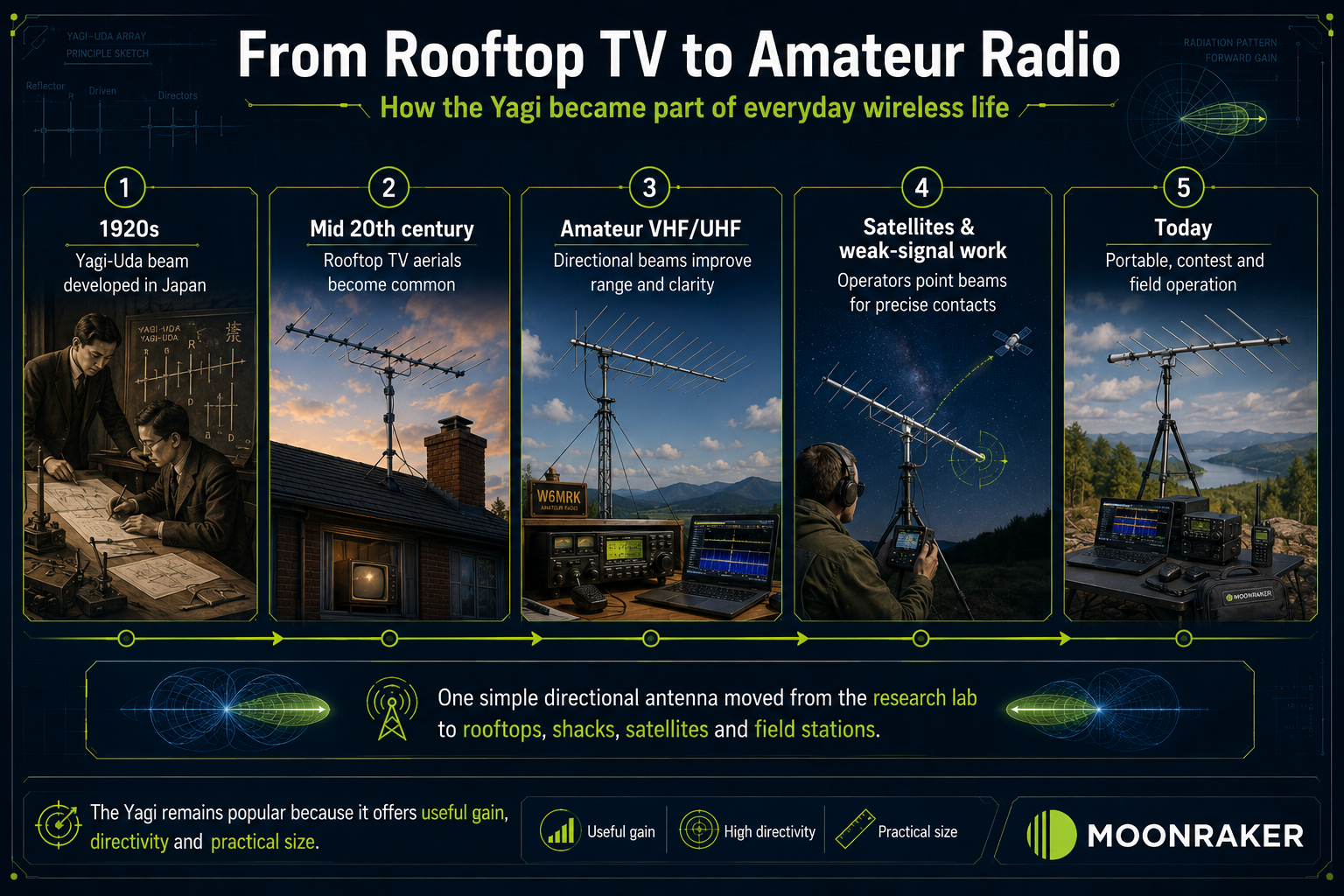
This is where the Yagi-Uda antenna became so important. Work on the design began at Tohoku University in Japan in the 1920s, with Professor Hidetsugu Yagi and Shintaro Uda associated with its development. The antenna was formally described in the 1926 paper Projector of the sharpest beam of electric waves, and modern historical accounts generally recognise the contribution of both Yagi and Uda.
The Yagi-Uda Breakthrough
At first glance, a Yagi looks simple. It is usually made from a boom with several metal elements mounted across it. One element is connected to the feeder. The others are not. That is the part that surprises many beginners.
The connected element is called the driven element. This is where the transmitter or receiver is connected. Behind it sits a reflector, usually a little longer than the driven element. In front of it sit one or more directors, usually a little shorter. These extra elements are known as parasitic elements because they are not directly connected to the radio. They work because energy from the driven element induces currents in them. Those induced currents then re-radiate energy of their own.
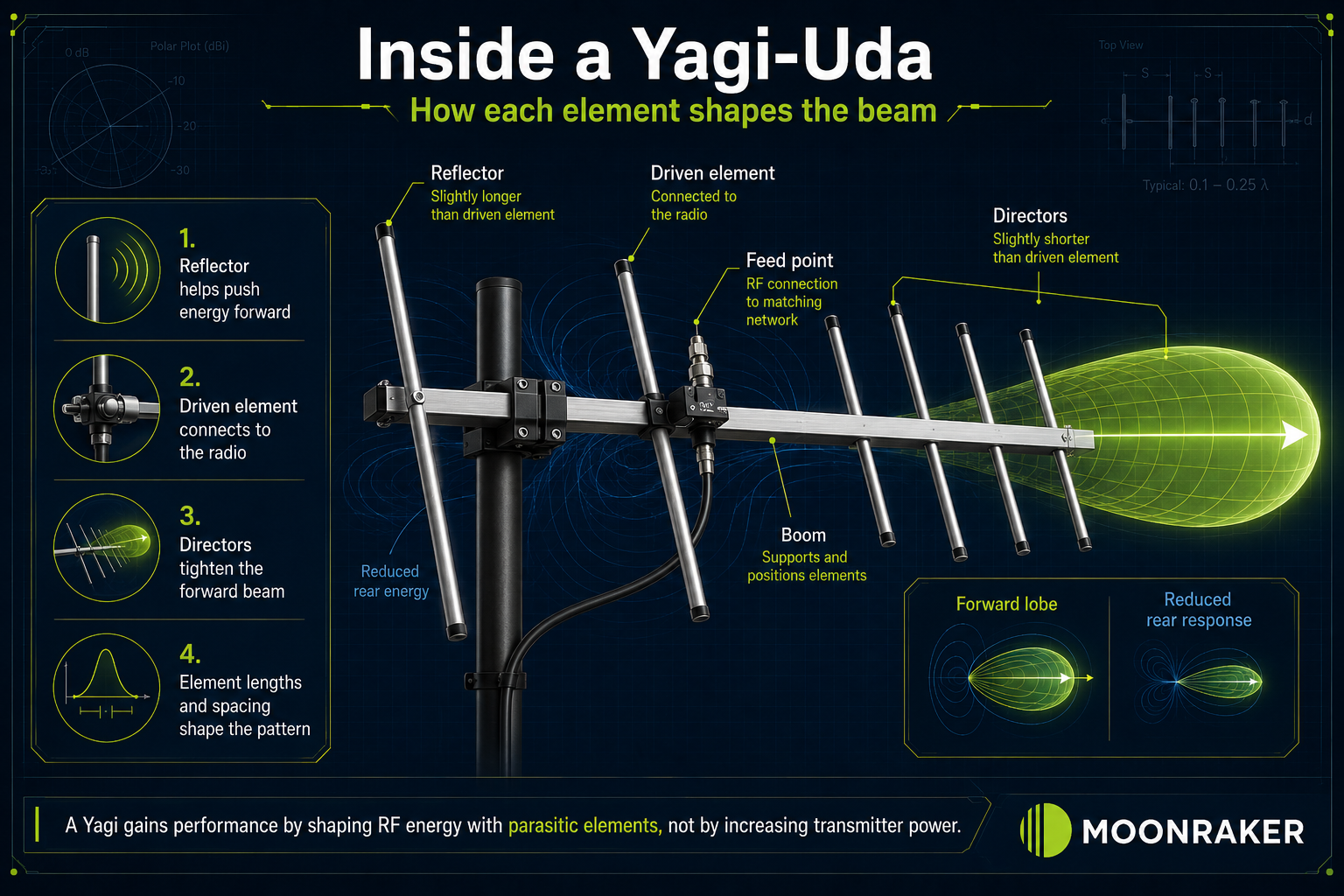
When the lengths and spacing are correct, the energy from all these elements combines in a useful way. It reinforces the signal in the forward direction and reduces it in other directions. The result is a directional beam.
The Yagi-Uda antenna is built from parallel conducting elements arranged as an end-fire array, normally using a driven element, directors and reflectors. Its directivity is created by careful element lengths and spacing, rather than by active electronics or amplification.
Gain Without Amplification
One of the most useful lessons from the Yagi is that antenna gain is not magic. A Yagi does not create extra transmitter power. It does not act like an amplifier in the usual sense. Instead, it takes the energy available and concentrates more of it in the direction you want.
A useful comparison is a torch. A bare bulb sends light in many directions. Put that same bulb inside a reflector, and the light becomes more useful because it is focused. The bulb has not become more powerful, but more of its light is now going where you need it.
The same basic principle applies to a directional antenna. A Yagi improves performance by controlling the radiation pattern. More energy is sent forward. Less energy is wasted to the sides and rear. On receive, the same pattern helps favour the wanted signal while reducing signals and noise from other directions.
For the radio amateur, this can be the difference between hearing a weak signal and missing it completely.
Why Direction Matters
Directionality is one of the most powerful tools in radio. It gives the operator control.
On transmit, a directional antenna helps put more of the signal towards the other station. On receive, it can improve the signal-to-noise ratio by favouring signals from one direction and reducing interference from others. On crowded bands, this can be just as valuable as extra power.
On VHF and UHF, where signals often behave more like line-of-sight paths, directionality becomes especially useful. It helps with repeaters, simplex contacts, SSB weak-signal operation, FM satellites, contesting, aircraft scatter, tropospheric propagation and general long-distance work.
A small Yagi on a modest mast can make a dramatic difference. Add height, clear surroundings and accurate pointing, and the station becomes far more capable.
This is why many operators discover that the best upgrade is not always another radio. Very often, it is a better antenna system.
From Rooftop Television to the Radio Shack
For decades, the Yagi was one of the most recognisable antennas in everyday life. Millions of people had one on the roof, pointed towards the local television transmitter. Most never thought about element lengths, boom spacing or front-to-back ratio. They simply knew that when the aerial was pointing the right way, the picture improved.
That alone makes the Yagi one of the most widely seen pieces of radio engineering in modern history. Tohoku University’s IEEE Milestone notes that the Yagi-Uda antenna became important in radar, television and amateur radio, and later commentary also highlights its major role in home television reception before cable and other delivery systems became common.
For amateur radio, the same idea became central to VHF and UHF operating. On 2 metres, 70 centimetres and above, Yagis provide practical gain without needing enormous physical size. A handheld beam can be used for satellite work. A medium-sized beam can improve repeater access or simplex range. Larger arrays can support contesting, EME, meteor scatter and serious weak-signal operation.
The principle remains the same: focus the signal, control the pattern and improve the useful energy path.
The Simple Shape That Still Works
The continued success of the Yagi is partly because it is mechanically simple. It can be made from straightforward materials. It scales with frequency. It can be designed for portable work, home stations, marine use, commercial links, television reception, telemetry, monitoring and high-performance amateur installations.
However, simple does not mean crude. A good Yagi is not just a collection of metal rods placed on a boom. Small changes in element length, element diameter, spacing, feed arrangement and boom correction can affect gain, bandwidth, impedance and pattern shape.
That is why proper antenna design matters. A well-designed beam does not only produce forward gain. It must also present a sensible match to the feeder, behave predictably across the intended bandwidth and survive real-world installation conditions.
For the operator, this means better performance and fewer surprises.
What the Yagi Teaches Us About Radio
The real story of the Yagi is not only historical. It teaches one of the most important ideas in radio: energy must be managed.
Radio frequency energy is invisible, but it is not random. It can be guided, phased, reflected, absorbed, matched and focused. The same transmitter can perform very differently depending on what happens after the RF leaves the socket.
A poor antenna system can waste power as heat, mismatch, unwanted radiation or loss in the feeder. A good antenna system turns more of that available energy into useful signal.
That is why antenna choice matters so much. Power is only part of the story. Pattern, height, feedline quality, matching and installation all matter too.
The Yagi-Uda antenna is one of the clearest examples of this. It shows that intelligent design can do more than brute force.
The Modern Ham Connection
Today, the Yagi remains one of the most practical ways to improve a VHF/UHF station. It is still used because the basic physics are still sound. Whether you are working a local repeater from a difficult location, trying your first satellite contact, improving 2 metre SSB performance or building a more serious weak-signal station, a directional antenna can transform the experience.
The best part is that the principle is easy to understand. Point the beam where the signal is. Use the antenna’s pattern to help you. Reduce what you do not want. Improve what you do.
That is radio engineering at its most useful.
At Moonraker, we supply a wide range of amateur radio antennas, accessories and station equipment to help operators get more from their signals. Whether you are building a first VHF/UHF setup, upgrading a base station or experimenting with directional antennas, the right aerial system remains one of the most effective improvements you can make.
For more information please visit our online store or alternatively contact us and our team will be happy to assist you!